 Safety and compliance software for carriers
Know who’s out of compliance.
CORE™ tracks every compliance deadline across your drivers data contained within siloed systems — documents, inspections, training, corrective actions — and holds anyone whose file isn’t current out of dispatch. You find out what’s coming due before it’s late, not after.
Safety stops being a filing job.
CORE™ plugs into the systems you already run — telematics, cameras, your MVR provider, the TMS dispatch lives in — and responds to what a driver does, good and bad, while it still matters. That consistency is what keeps good drivers, and what keeps the file straight.
Consistent, near real-time response to behavior — good and bad — is what keeps a good driver from leaving over something avoidable.
Intervene on the violation you can see today instead of the crash you find out about later.
Scheduled by qualification date or document expiry, across the fleet or one driver at a time, on your calendar rather than a vendor's.
Safety, DQ files, scorecards, video and MVRs in the same record, visible across platforms.
The inspection isn’t over when the truck pulls away.
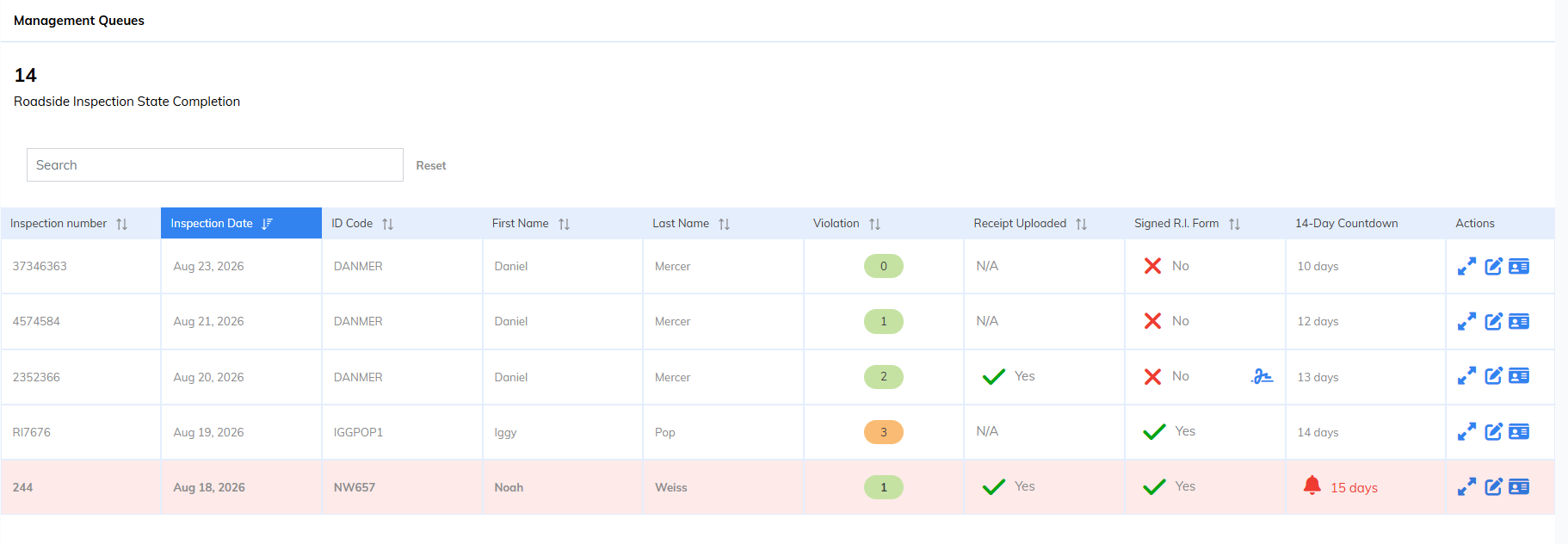
Every inspection has to be reviewed, signed and returned to the issuing state before the window closes. CORE™ Fleet Safety counts it down from the inspection date, keeps signature and receipt status alongside it, and turns the row red the moment it runs out.
The whole safety department, in one record.
Documents, inspections, driver behavior, training, testing and the paperwork that follows an incident. All of it in one record, working against the same driver, so nothing ends up in a spreadsheet on somebody’s desktop.
DQ File Management
CDLs, medical cards, MVRs and every other DOT-required document tracked against every driver, with renewal monitoring that runs whether or not anyone remembers to look. A driver with a missing or expired document is marked inactive, so dispatch cannot put them on a load.
- Renewal monitoring that never sleeps
- Paperless form completion
- Out-of-standard drivers made inactive automatically
- Audit packet is a request, not a fire drill
Catches a license that changed between annual reviews — an endorsement removed, a restriction added, a class downgraded, a state switched.
Inspections reviewed, signed on screen and returned to the issuing state on time.
Critical events, corrective actions, telematics and the driver scorecard in one workflow. Points come off for training done on time, not just on for events.
Alerts on a driver’s motor vehicle record as activity happens, straight from your provider, so a violation reaches you before your insurer finds it.
Automatically reviews each driver’s annual MVR for violations, license issues, and other disqualifying events.
Assigned by qualification date or document expiry, repeating weekly, monthly or yearly. Integrates with Luma.
What happened at the scene, captured and routed into the driver’s record rather than a folder somebody has to find later.
Ordered inside the application, with a location map so the driver knows where to go.
Hours-of-service violations tracked from detection through to resolution.
Tracked against the driver record, alongside everything else that shapes a scorecard.
Carriers run one or the other, not both. Asset Management, On Demand Orientation and Drip Marketing are separate solutions rather than safety modules.
Hard to describe. Easier to watch.
Critical events, coached
A hard-braking event arrives from the camera and lands on the driver’s record with the video attached. The reviewer picks the trigger, assigns the corrective action and the points, and it is tracked to signature from there.
Where the events actually happen
Every critical event on a map you can zoom to street level. Clusters tell you something a list never will — that a yard exit, an on-ramp or one customer’s dock is producing the same event over and over.
The driver signs it themselves
The driver opens their own portal, watches their own event video, reads the corrective action and signs it with a mouse or a finger. Nobody chases a piece of paper around a terminal.
Tests and physicals, ordered in-app
Ordered inside CORE™ Fleet Safety rather than by phone, with a location map so the driver knows exactly where to go and the result comes back into the same record.
Ask your safety data a question nobody built a report for.
CORE™ connects to the AI agents your team already uses, over a secured connection to your own data. It answers, and then it does the next thing.
›
The pieces most carriers ask for next.
Expiration dates on the equipment files, tracked the same way the driver files are.
Monitors CSA scores and safety data to identify violations, risk trends, and areas requiring attention.
Vehicle inspection reports and the repair receipts that close them out, in the same record.
GPS location of a truck, pulled through your dispatch integration.
InfoStream is EBE’s managed services team. They run the same platform on your behalf — auditing documents for completeness, flagging what is short, entering roadside inspection detail — so your safety director spends their time on driver behavior instead of renewals.
What carriers report after switching.
The outcomes a safety director actually gets asked about, rather than activity metrics.
insurance costs
scores
recordables
administrative work
risk labor costs
renewal delays
Our terminal managers now have more control over driver compliance with accident reporting and follow-up. The solution allows our Transportation Safety Department to focus on more urgent requests and new driver files.

EBE’s CORE Fleet Safety helped us improve our compliance and risk management processes to become a safer and more compliant fleet.
We’ve seen the gains from implementing these solutions, and that’s why we keep going back to EBE. By the time we’re done, I don’t think there will be a solution that EBE offers that we don’t have.

Start with where you actually stand.
CORE is built around the four things an attorney, an underwriter or a DOT auditor will ask you to produce. Before you book anything, find out how quickly your program could produce them today.
Pick a driver at random. How long to produce their complete DQ file?
Your MVR provider, your telematics, your TMS.
CORE™ Fleet Safety pulls from the systems already feeding your safety program, so the data arrives on its own rather than being keyed in twice.
Screening and MVR







Telematics, training and TMS







// IF YOUR PROVIDER ISN’T HERE, ASK — THE LIST GETS LONGER EVERY YEAR.
A Safety Mindset: why it should be a priority for transportation companies
Priorities change, sometimes daily. A value doesn’t. This paper looks at historical trends, current process, best practice and the technology that supports a safety culture — and at the question underneath all of it: how do we actually accomplish our safety mission?
Download the white paper →
The questions we get on every first call.
Asked and answered here rather than in week three of an evaluation.
What happens to a driver whose medical card lapses?
CORE™ marks them inactive automatically and flags dispatch, so they can’t be assigned a load until the file is current. That’s the part carriers usually build by hand and then forget to maintain — and it’s the difference between a finding and a violation.
Do we have to buy all of it?
No. Every module is priced on its own. Most carriers start with DQ File Management, because that’s often the only safety piece they need, and add roadside inspections or driver performance when the exposure moves.
We already have telematics. Does this replace it?
No. CORE™ sits above it. Critical events from your camera and telematics systems come in and attach to the driver’s record alongside their DQ file, MVR history and scorecard, so the incident and the file are in the same place when you need them together.
The AI connector reaches our driver data. What are the limits?
It connects over a secured connection to your own data, and it sits inside the same SOC 2 scope as the rest of the platform. It’s available today, not on a roadmap. It both answers questions and takes actions — ordering a report, sending a message — and every action it takes is recorded against the driver like any other.
How much of this can we hand off entirely?
All of it, if you want. InfoStream is EBE’s managed services team and they run the same platform on your behalf — the ordering, the chasing, the auditing — while your safety director spends their time on driver behavior.
What does this actually change on audit day?
You stop assembling. Every required document is already in the driver’s file with its status and history, so the audit packet is a request rather than a fire drill.
Ask it before you commit to a meeting.
Different departments,
the same Digital Workforce.
Send us one driver file.
Pick the messiest one you’ve got. We’ll show you what CORE™ already knows about it, what it would have flagged, and how far ahead of the deadline you’d have heard about it.