The $500,000 Back Office Employee You Didn’t Know You Had
I was speaking with the CFO…

I was speaking with the CFO of a transportation company recently, who was frustrated that every increase in freight volume seemed to require another back-office hire. The Accounts Payable and Billing teams spent hours everyday processing carrier invoices, uploading supporting documents into customer web portals, checking payment status across dozens of websites, and manually tracking exceptions. Despite investing in technology, their staff were still performing thousands of repetitive clicks each week.
As we mapped the process, an interesting realization emerged. The problem wasn’t headcount. The problem was that highly skilled employees were spending their days acting as data entry clerks, document upload specialists, and payment status investigators.
In many organizations, this hidden workload is spread across Accounts Payable, invoicing, settlements, collections, and customer web portals. No single task seems significant on its own. Upload a POD. Check the payment status. Attach a lumper receipt. Update a customer portal. Repeated hundreds or thousands of times each week.
Collectively, these activities create the equivalent of a full-time employee—or several of them. In larger transportation companies, the annual cost of this hidden workforce can easily exceed $500,000.
That is the $500,000 Back-Office Employee: not a person sitting at a desk, but a collection of repetitive manual tasks quietly consuming time, delaying cash flow, and preventing your team from focusing on higher-value work.
Every transportation company knows how to optimize a route to save a few pennies per mile. But while operations teams obsess over fuel costs and deadhead miles, significant revenue is quietly evaporating in the back office.
Consider a single Proof of Delivery (POD) sitting unread in an inbox for six hours, a load tender re-keyed across three different screens, or a driver settlement delayed by a manual safety record check. That is where the real leak happens. You might not see it on the payroll, but this operational waste creates a hidden cost structure that behaves exactly like an employee—a very expensive, “hidden employee” made up entirely of repetitive manual tasks across your Accounts Payable, invoicing, settlements, and collections workflows.
Across freight invoicing, settlements, collections, document management, and load tender processing, many transportation organizations dedicate the equivalent of multiple full-time employees to repetitive administrative work. When labor costs, delayed cash flow, missed revenue opportunities, overtime, and exception management are combined, the cost of these manual workflows can easily reach hundreds of thousands of dollars annually.
The Problem: Smart People Trapped by Repetitive Work
The back office is the engine that actually gets you paid. But right now, incredibly capable staff are bogged down by data entry and manual routing. The hidden workload you are paying for forces skilled people into mind-numbing routines: manually matching freight invoices, cross-referencing load tenders, and chasing down exceptions.
For a growing carrier or brokerage, the goal isn’t to replace your workforce. Instead, the focus should be on Workflow Automation in Transportation: the process of capturing, validating, and routing data automatically across disconnected systems so human staff only intervene for exceptions. By leveraging this solution, your team can stop doing repetitive recordkeeping and focus their brainpower on resolving complex exceptions and improving customer service.
Where are transportation companies losing money to manual workflows?
Transportation companies lose significant revenue to manual bottlenecks in three primary areas: disconnected systems, invoice processing lag, and missed assessorial collections. The financial bleed rarely comes from one massive failure; it’s a series of manual touchpoints across your daily operations:
When you add up the manual touchpoints across freight invoicing, driver settlements, and exception handling, the operational impact directly inflates your cost-per-load. In fact, Ryder estimates that supply chain inefficiencies can consume 20% to 30% of total operating costs, with manual workflows driving up labor expenses by as much as 15% compared to automated environments.
How does automation manage transportation exceptions?
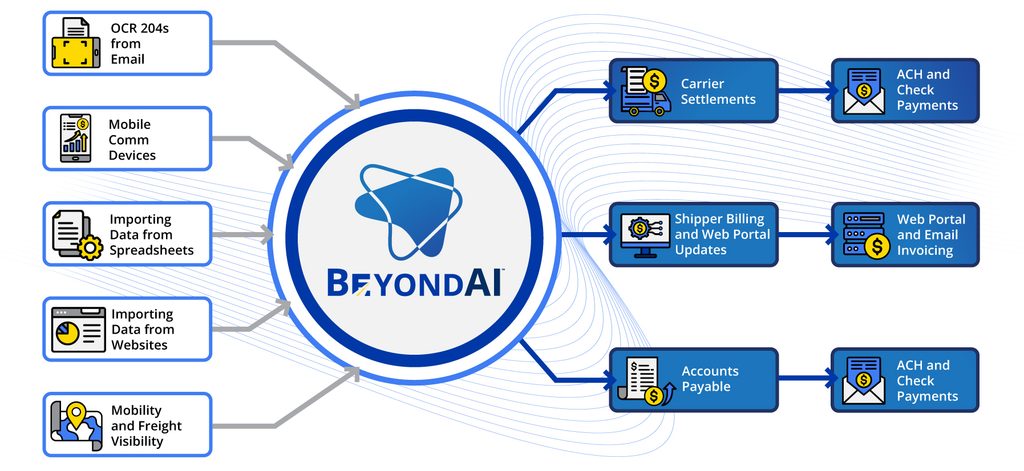
Automation allows standard transactions to move automatically through your operation, reducing manual touchpoints while ensuring exceptions receive the attention they deserve. It isn’t just about reading documents; it’s about capturing, validating, and intelligently routing work across your entire operation.
By implementing proactive workflows, data is extracted and validated the moment a document is captured. As we’ve seen at EBE Technologies, automation serves as an initial filter. It automates repetitive tasks for standard document matching, and routes exceptions to the right person for review. Your people get to use their operational expertise, while the software reduces manual touchpoints and accelerates the cycle.
The same approach can be applied to inbound load tenders, where automation can capture shipment details, create orders, and route exceptions without requiring dispatchers to manually re-key information.
What is the ROI of automation within transportation?
When deployed strategically, the return on investment from automation drives immediate, tangible improvements in processing speed, accuracy, and cash flow.
How do you start automating transportation workflows?
You do not need to rip and replace your existing TMS or accounting software. In fact, the most powerful workflow automation is designed to sit directly alongside your current systems by adding value, bridging the gaps between them, and keeping your existing operations moving seamlessly.
Here is how to target your biggest bottlenecks operationally:
The Real Opportunity
Transportation companies rarely have a labor problem. More often, they have a workflow problem.
Every day, skilled employees spend hours moving information between disconnected systems, re-keying data, and chasing documents that should already be flowing automatically. The opportunity isn’t to replace people. It’s to eliminate the repetitive work that prevents them from delivering greater value.
For organizations willing to automate routine processes and manage by exception, that hidden $500,000 employee may be the easiest cost reduction opportunity in the business.
Frequently Asked Questions (FAQ)
At EBE, we work with transportation and logistics companies every day to uncover hidden operational costs across the back office—from freight invoice processing and customer portal updates to settlement workflows, collections activities, and Accounts Payable processes throughout the organization, including vendor management and maintenance-related purchasing within the shop.
Drawing on decades of transportation industry experience, we help organizations map these workflows, quantify the effort involved, and identify opportunities to improve efficiency, improve cash flow, and support growth without sacrificing service levels or adding headcount.
If you’d like an objective assessment of where operational waste may exist within your organization, we’d welcome the opportunity to help.
About the Author:

Bill Holaday, VP of Enterprise Sales
Bill has spent more than 35 years in transportation and logistics, with experience spanning carrier operations, IT, sales, and transportation technology. He works with fleets across North America to identify operational challenges and implement solutions that reduce friction and improve performance.
Contact Bill:
309-792-5550
[email protected]